
Agile Courses
Develop the skills to apply Agile to project management, teamwork and leadership, with practical training designed for different professional contexts.
Agile is not a recipe that can be applied in exactly the same way to every team, project or organisation.
It is a way of thinking about work, making decisions and responding to change. In practice, it means working collaboratively, delivering value incrementally, learning from experience and adapting the approach as the context evolves.
That is why good Agile training should go beyond explaining frameworks, roles or practices. It should help professionals understand the principles behind them and, more importantly, know when and how to apply them.
At XPM Consulting, our Agile courses combine structured knowledge with practical situations, examples and exercises based on real professional contexts.
What are Agile courses?
Practical Agile training
An Agile course helps professionals understand Agile principles, practices and ways of working and see how they can be applied in a professional environment.
Training can cover different areas, from project management and team collaboration to leadership, facilitation and Agile Coaching.
The goal is not simply to learn concepts. It is to understand how to apply them when you return to work.
What can you develop through Agile training?
Depending on the course, participants may develop skills in:
- Agile project management and planning
- Prioritisation and work organisation
- Team collaboration and development
- Facilitation
- Leadership in Agile environments
- Coaching
- Continuous improvement
- Adapting to change
Each course has its own objectives and content, depending on the area of expertise it is designed to develop.
Agile in different contexts
Agile is used across different types of organisations, teams and projects.
It can be applied to product development, project management, multidisciplinary teams and organisational transformation.
A practice that works well for one team may not work in exactly the same way for another. Understanding the principles behind Agile helps professionals make better decisions when adapting the approach to their specific context.
What types of Agile training are available?
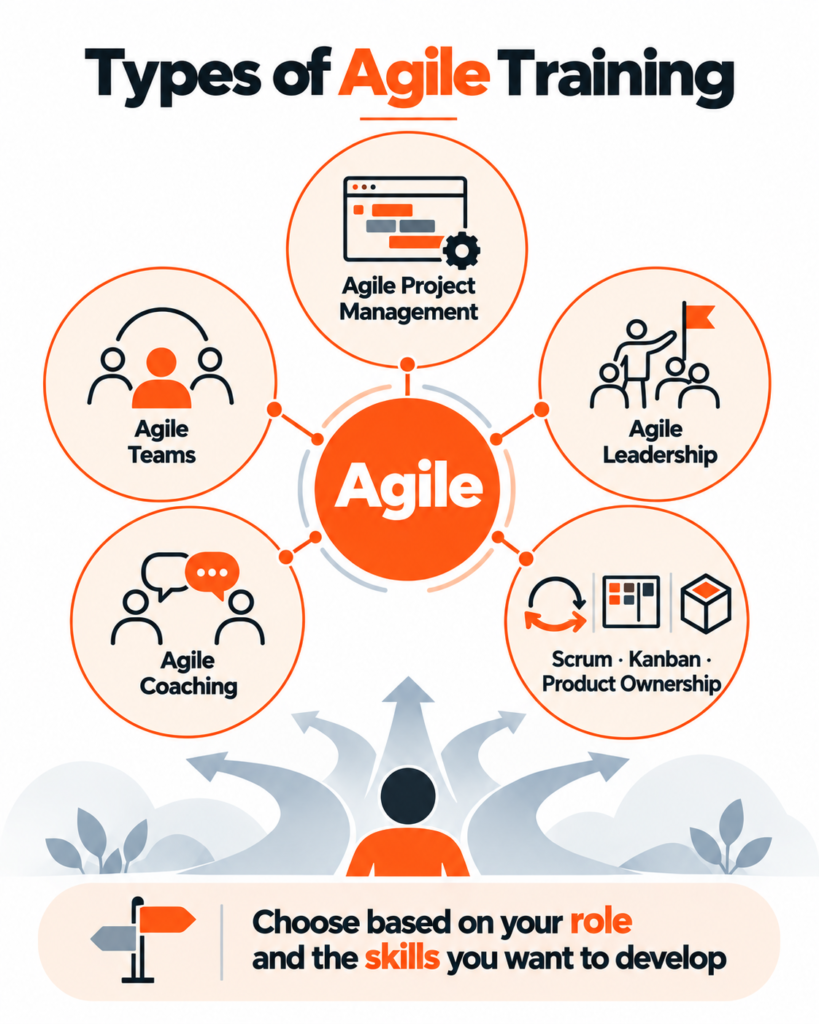
There is no single Agile training path. The right choice depends on your role, experience and the skills you want to develop.
Agile Project Management
Agile Project Management training focuses on applying Agile principles and practices to project management.
It is suitable for Project Managers and other professionals involved in projects who need to work in changing environments, manage evolving priorities and integrate Agile approaches into their work.
Agile Teams
Agile Teams training focuses on the people doing the work.
It covers collaboration, work organisation, facilitation, team development and continuous improvement, helping participants understand what contributes to an effective Agile team.
Agile Leadership
Agile Leadership training focuses on leadership in environments where autonomy, collaboration and adaptability are important.
It covers areas such as leadership, team development, facilitation and creating the conditions that enable teams to take greater ownership of their work.
Agile Coaching
Agile Coaching training develops the skills needed to support people and teams as they adopt and evolve Agile ways of working.
Coaching, facilitation, collaboration, team development and continuous improvement are some of the key areas covered.
Agile Product Owner
For professionals responsible for maximising product value who want to develop skills in product management, prioritisation and value definition.
Other Agile skills and practices
Agile is also connected with areas such as Scrum, Kanban, Product Ownership, facilitation and Agile transformation.
Not all of these areas are relevant to every role. The important thing is to identify the skills you want to develop and choose your training accordingly.
Find the right Agile course
XPM Consulting offers Agile training courses designed for different professional roles and development needs.
Agile Project Management
For professionals who manage or contribute to projects and want to apply Agile principles and practices to planning, delivery and project work.
Explore the Agile Project Management course → https://xpmconsulting.com/en/course/agile-project-management/
Agile Teams
For professionals working with Agile teams who want to develop their skills in collaboration, facilitation, work organisation and continuous improvement.
Explore the Agile Teams course → https://xpmconsulting.com/en/course/agile-teams/
Agile Leadership
For managers and leaders working with teams who need to adapt their leadership approach to Agile environments.
Explore the Agile Leadership course → https://xpmconsulting.com/en/course/agile-leadership/
Agile Coach
For professionals who support people, teams and organisations in adopting and evolving Agile ways of working.
Explore the Agile Coach course → https://xpmconsulting.com/en/course/agile-coach-certification/
Agile Product Owner
For professionals responsible for maximising product value who want to develop skills in product management, prioritisation and value definition.
Explore the Agile Product Owner course → https://xpmconsulting.com/en/course/product-owner-certification/
Agile courses that connects with real work
Agile is easier to learn when concepts can be connected to real situations.
A team may know Scrum and still struggle with collaboration. A Project Manager may understand Agile practices but find it difficult to manage a project where requirements and priorities keep changing. A leader may want to give a team more autonomy without knowing how to change their own approach to leadership.
Knowing about Agile is one thing. Knowing how to work in an Agile way is another.
Our courses combine concepts and practices with examples, exercises, discussions and activities that help participants connect what they learn with their own professional context.
The experience of the trainer also matters. Training should be based not only on knowledge of Agile frameworks, but also on experience applying them in different situations and organisational environments.
Agile courses formats
Our Agile courses are available in different formats, allowing professionals and organisations to choose the option that best fits their needs.
Classroom training
Classroom training provides direct interaction with the trainer and other participants.
Exercises, discussions and group activities create opportunities for close interaction throughout the training.
Virtual training
Virtual Agile training allows participants to join remotely through videoconferencing while maintaining interaction with the trainer and the rest of the group.
It is particularly suitable for professionals and teams working across different locations.
Elearning
Agile elearning allows participants to study independently and manage their learning around their own schedule.
It is particularly suitable when flexibility is a priority.
How do the different formats work?
The right format depends on the type of training, your availability and how you prefer to learn.
For teams, classroom or virtual training can help create a common language and provide opportunities to discuss situations from their own working environment. Elearning can offer greater flexibility for individual learning.
Agile certifications and certification training
Training and certification are two different things.
An Agile training course helps you acquire knowledge and develop skills. An Agile certification is a qualification awarded by a certification body after the relevant requirements have been met and, where applicable, an assessment has been completed.
Some courses are specifically designed to prepare participants for a certification. Others focus primarily on developing skills that can be applied directly at work.
If certification is part of your goal, check the relevant requirements, content and assessment format and choose training that supports that certification path.
Explore Agile certifications:
- Agile Project Management → https://xpmconsulting.com/en/course/agile-project-management-certification/
- Agile Coach → https://xpmconsulting.com/en/course/agile-coach-certification/
- Agile Product Owner → https://xpmconsulting.com/en/course/product-owner-certification/
How to choose Agile courses
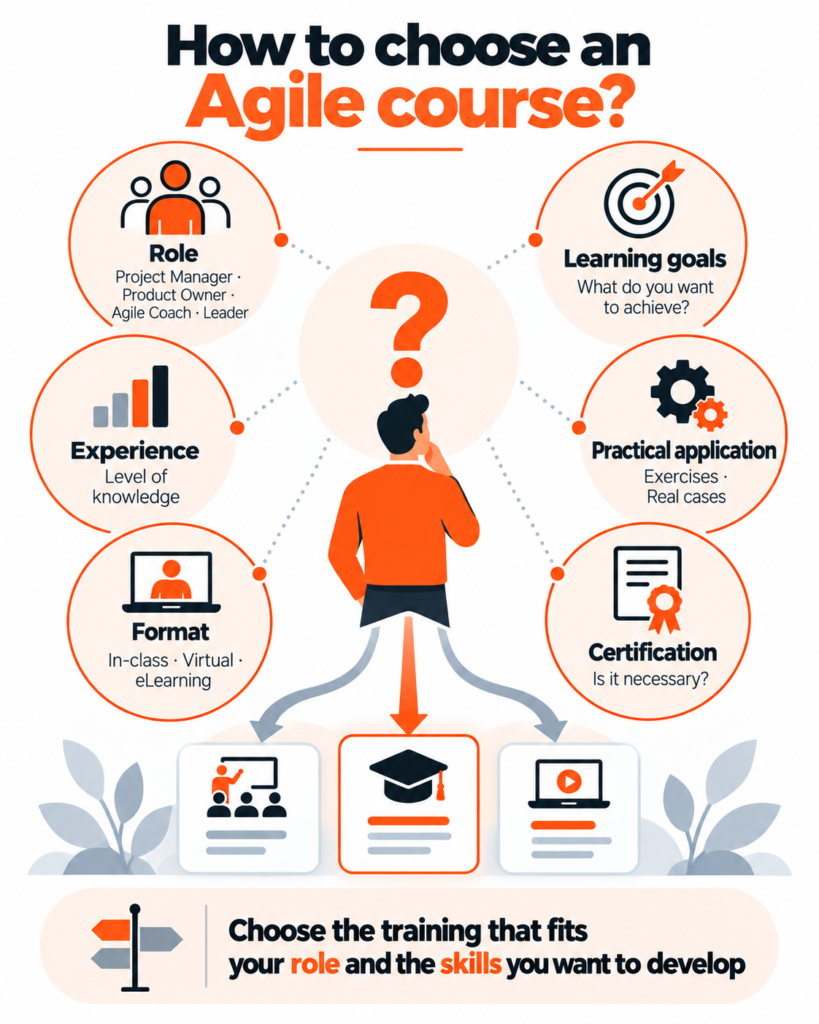
The right Agile course is the one that matches what you want to be able to do after the training.
Your professional role
A Project Manager, Scrum Master, Product Owner, Agile Coach or team leader may have very different training needs.
Starting with your current role can help you identify which area of Agile is most relevant to you.
Your learning objectives
Think about what you want to be able to do after the training.
You may want to improve project management, develop a team, strengthen your facilitation skills, lead in an Agile environment or develop coaching skills.
Your previous experience
Your starting point also matters.
Someone new to Agile will have different needs from someone who already works with Scrum, manages projects or leads teams. Training should provide an appropriate level of depth for the participants’ existing knowledge and experience.
Practical application
If you want to use what you learn at work, look for Agile training that goes beyond explaining concepts.
Exercises, practical examples and discussions of real situations help turn knowledge into the ability to apply it.
Training format
Consider your availability, location and preferred way of learning. Classroom, virtual and elearning formats provide different learning experiences.
Certification requirements
If you want to obtain an Agile certification, check whether the course is designed to support the certification you are pursuing and whether it meets the relevant requirements.
Not every Agile course is designed around certification, and different certifications may have different preparation requirements.
Agile courses backed by experience
XPM Consulting has been working in project management, Agile and professional development for 20 years.
Over this time, we have trained professionals from different sectors, roles and countries and worked with organisations facing very different challenges.
That experience shapes the way we deliver training.
We do not teach Agile as a collection of isolated concepts. We focus on how Agile principles and practices can be used to address real problems, make decisions and improve the way people work together.
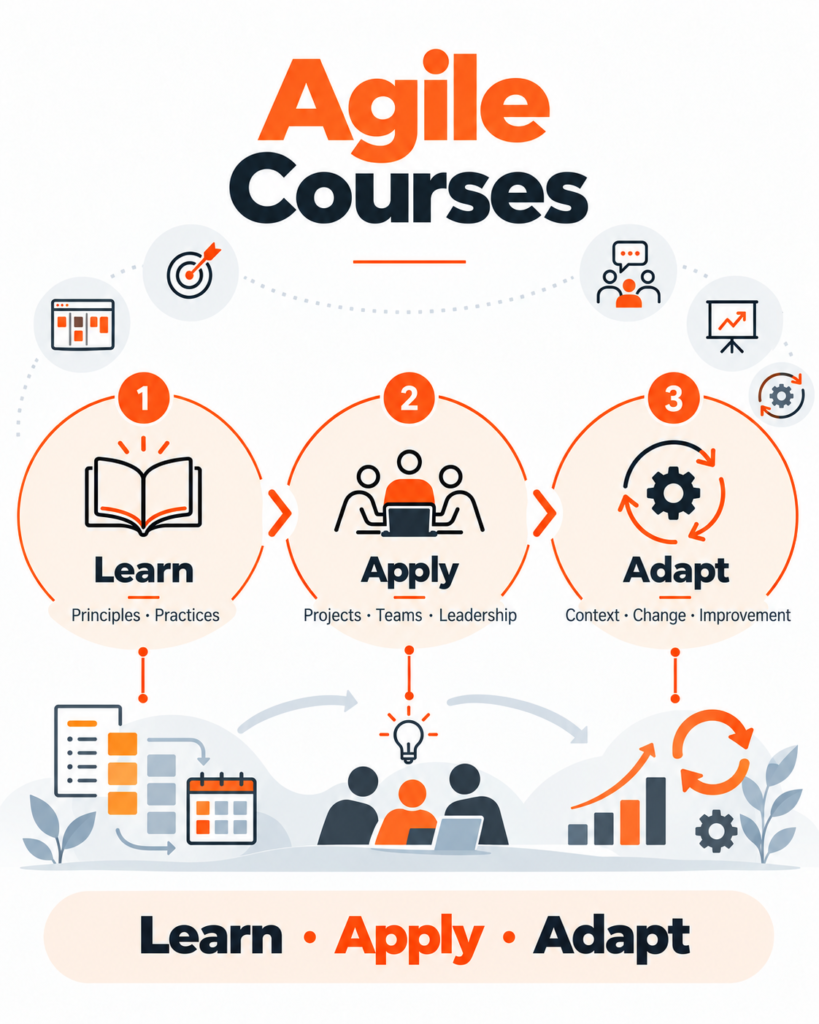
Learn. Apply. Evolve.
That is the approach behind our Agile training.
View all Agile courses → https://xpmconsulting.com/en/training/#agile_courses
Talk to XPM Consulting → Call us at +351218061742 or send us an email to office@xpmconsulting.com
Frequently asked questions about Agile courses
What are Agile courses?
Agile courses help professionals understand and apply Agile principles, practices and ways of working. They may cover areas such as Agile Project Management, Agile Teams, Agile Leadership and Agile Coaching.
Who are Agile courses for?
Agile courses are suitable for professionals who work or want to work in Agile environments, including Project Managers, Scrum Masters, Product Owners, Agile Coaches, team leaders and other professionals involved in projects and teams.
Do I need Agile experience to take an Agile course?
Not necessarily. There are Agile training courses for different levels of experience. The important thing is to choose a course that matches your existing knowledge and learning objectives.
What types of Agile courses are available?
Agile training covers different areas, including Agile Project Management, Agile Teams, Agile Leadership and Agile Coaching. There are also courses focused on Scrum, Kanban, Product Ownership and other Agile practices.
What is the difference between Agile courses and Agile certification?
Agile training helps you acquire knowledge and develop practical skills. An Agile certification is a qualification awarded by a certification body after the relevant requirements have been met and, where applicable, an assessment has been completed.
Do Agile courses include certification?
It depends on the course. Some Agile courses are designed to prepare participants for a specific certification, while others focus primarily on developing practical skills. The conditions should be checked for each course.
Can I take an Agile course if I do not work in an Agile role?
Yes. Agile training can be useful for professionals who are new to Agile or work in organisations that are adopting or developing Agile ways of working.
Are Agile courses only for project management professionals?
No. Agile is used across different roles and teams. Agile training can be relevant to professionals working in project management, product, team development, leadership, coaching and other areas.
Can I take an Agile course online?
Yes. Agile courses are available in virtual and elearning formats. The available formats depend on the individual course.
What is the difference between classroom, virtual and elearning Agile courses?
Classroom training takes place in person with the trainer and other participants. Virtual training is delivered online through videoconferencing while maintaining interaction with the trainer and the group. Elearning allows participants to study independently with greater flexibility.
How do I choose the right Agile course?
Start with your professional role, your existing knowledge and what you want to develop. Also consider the practical component, the training format and, if relevant, the requirements of the certification you are pursuing.
Do Agile courses include practical exercises?
The practical component depends on the course, but XPM Consulting’s Agile training aims to connect concepts with professional situations through exercises, examples and practical activities.
Does Agile courses prepare me for a certification?
Some Agile courses are designed to prepare participants for a specific certification. In that case, check that the course content, requirements and format are aligned with the certification you intend to pursue.