
ITIL
Learn about ITIL, its principles, concepts and evolution, and understand how the framework supports the management of digital products and services. Explore the different versions and the main ITIL certification pathways.
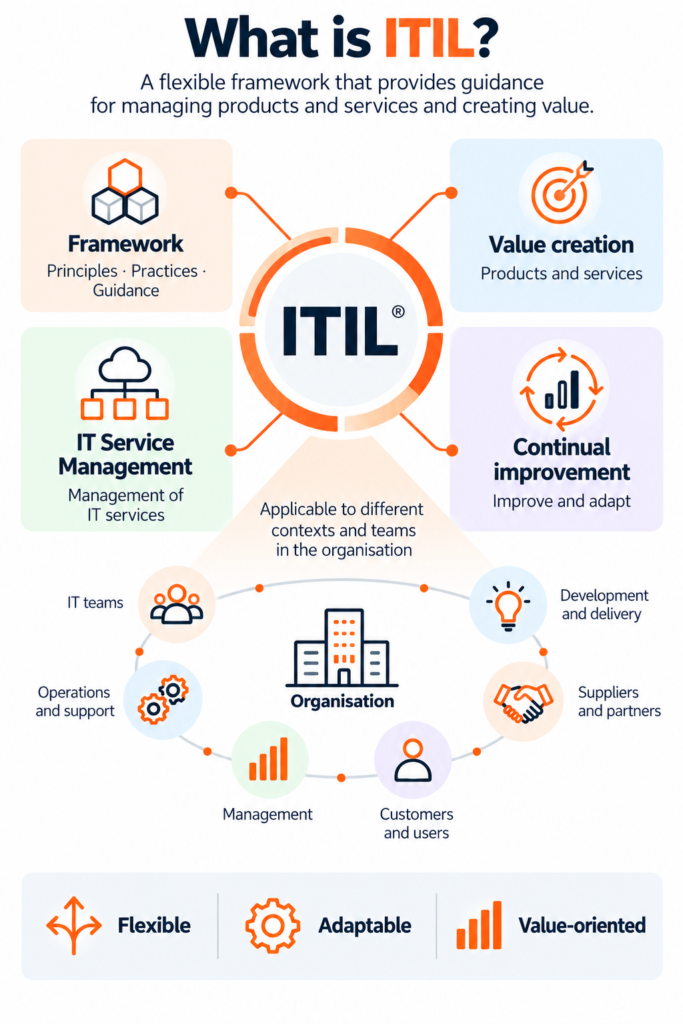
ITIL is a reference framework for IT service management. It is used by organisations to structure, manage and improve how services are designed, delivered, supported and improved.
Over time, ITIL has evolved from an approach focused on IT service management towards a broader view of products and services, value creation and continual improvement.
What is ITIL?
What does ITIL stand for?
ITIL stands for Information Technology Infrastructure Library.
ITIL originated as a set of guidance for managing technology services and has evolved into a reference framework used by different types of organisations and in different contexts.
What is ITIL as a framework?
ITIL is a framework, not a rigid methodology or a set of mandatory procedures.
It provides concepts, principles, practices and guidance that can be adapted to each organisation’s context. Its application can vary according to the organisation’s services, products, objectives, structure and circumstances.
What is ITIL used for?
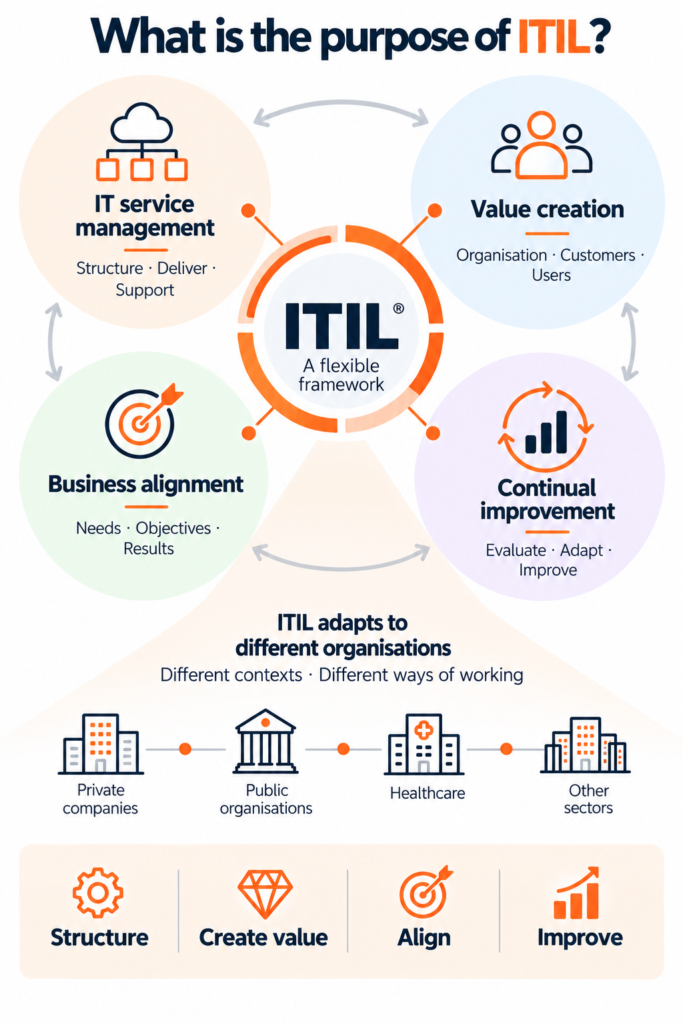
ITIL helps organisations structure the management of their products and services, with a focus on value creation, service quality and continual improvement.
The framework provides a common language and set of concepts for the different areas involved in managing and delivering services.
What is the relationship between ITIL and IT service management?
ITIL is directly related to IT Service Management (ITSM), the discipline of managing IT services.
ITSM covers how an organisation plans, delivers, supports and improves its IT services. ITIL provides a reference framework that can be used to structure this management.
Where is ITIL used?
ITIL can be applied in organisations of different sizes and across different sectors whenever there is a need to structure the management of products and services.
It is particularly relevant in environments where technology plays an important role in service delivery, business support or customer and user experience.
What is ITIL used for?
IT service management
ITIL provides guidance for structuring service management across the different activities involved in creating, delivering, supporting and improving services.
Creating and delivering value
One of the central principles of ITIL is creating value through products and services.
Value is not created solely by the service provider. It results from the interaction between the organisation, customers, users and other stakeholders.
Aligning IT services with business needs
Service management should be connected to the organisation’s needs and objectives.
ITIL helps establish this connection by considering the outcomes that customers and the organisation want to achieve.
Improving services
Continual improvement is an important part of ITIL. Services, practices, processes and ways of working can be assessed and improved as needs and circumstances evolve.
Applying ITIL in organisations
The framework can be adapted to different organisational models and ways of working. Applying ITIL does not mean implementing all its guidance in the same way or using every available practice.
How does ITIL work?
How ITIL works depends on the version being considered.
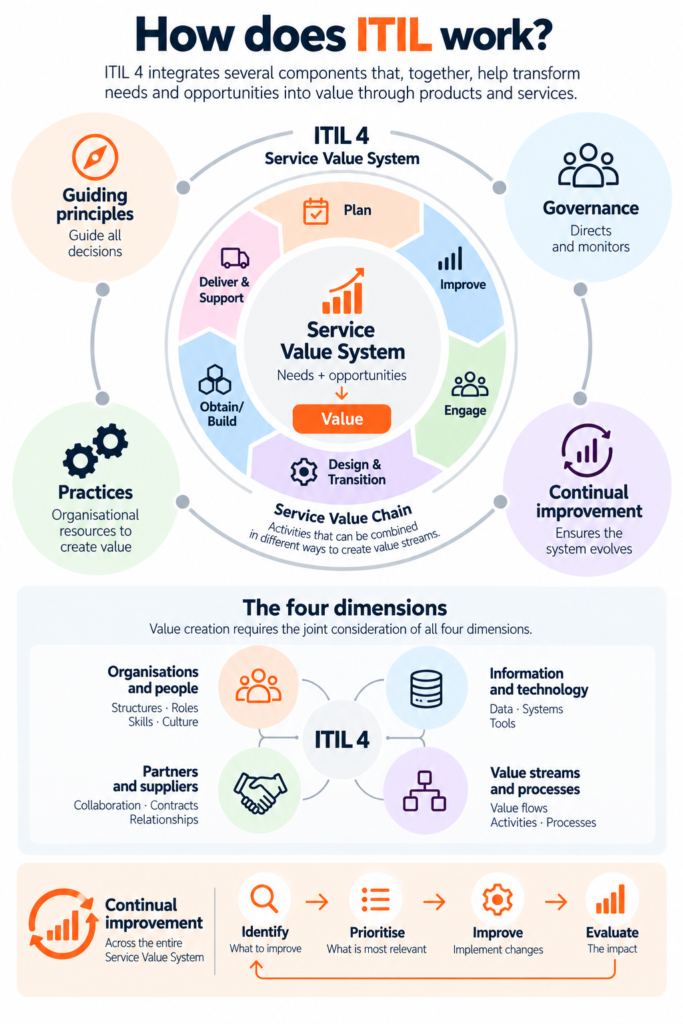
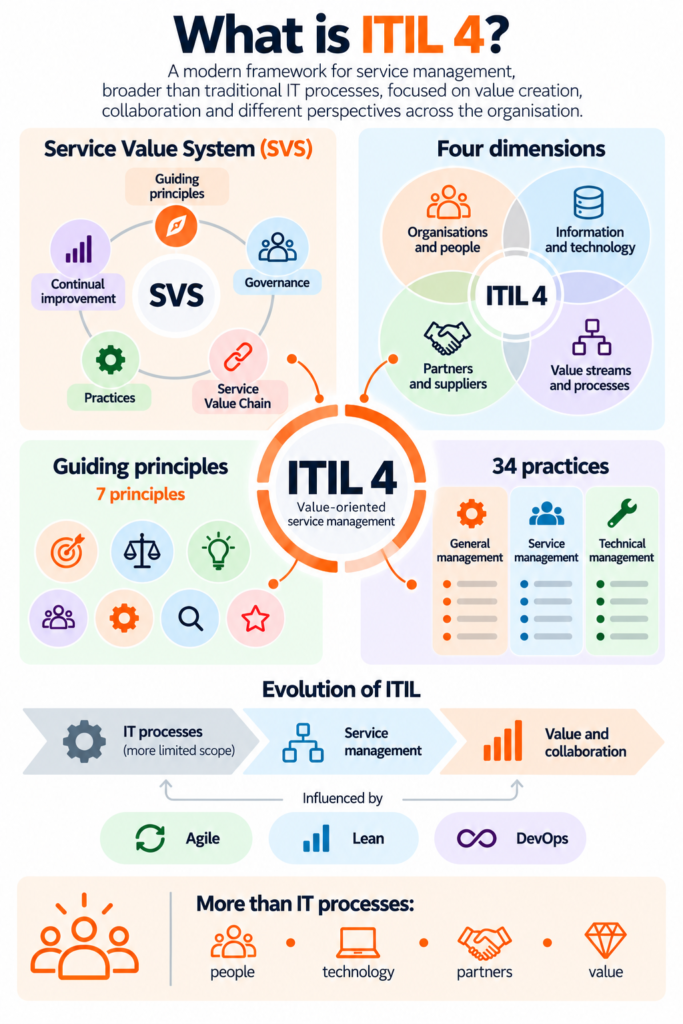
In ITIL 4, service management is structured through the Service Value System (SVS), which integrates guiding principles, governance, the Service Value Chain, practices and continual improvement.
These elements enable opportunities and needs to be transformed into value through the management of products and services.
Guiding principles
The ITIL 4 guiding principles help guide decisions and ways of working in different situations.
They include principles such as:
- Focus on value
- Start where you are
- Progress iteratively with feedback
- Collaborate and promote visibility
- Think and work holistically
- Keep it simple and practical
- Optimise and automate
Service Value System
The Service Value System (SVS) describes how the different components and activities of an organisation work together to facilitate the creation of value through services.
Service Value Chain
The Service Value Chain is an operating model in ITIL 4 that defines six activities:
- Plan
- Improve
- Engage
- Design & Transition
- Obtain/Build
- Deliver & Support
These activities can be combined in different ways to create different value streams.
Four dimensions of service management
ITIL 4 considers four dimensions that should be analysed in an integrated way:
- Organisations and people
- Information and technology
- Partners and suppliers
- Value streams and processes
These dimensions help avoid an exclusively technology-focused view of service management.
Continual improvement
Continual improvement is integrated with the other elements of ITIL. The aim is to identify improvement opportunities, set priorities, implement changes and assess the results.
What are the main ITIL concepts?
Service
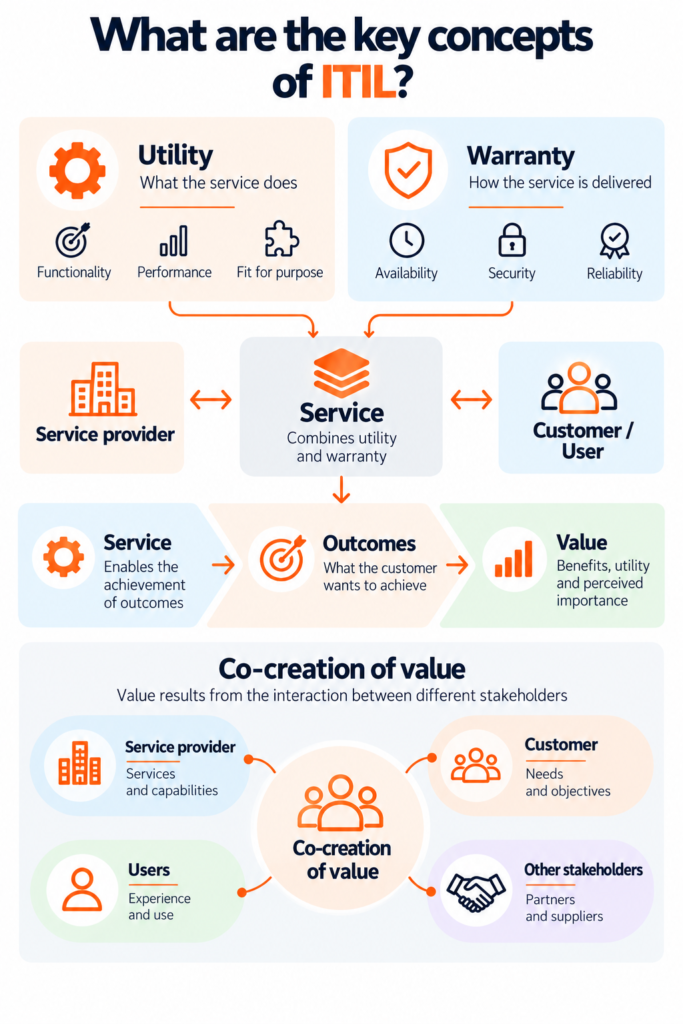
A service enables customers to achieve specific outcomes without having to manage the specific costs and risks associated with doing so themselves.
Value
Value refers to the benefits, usefulness and importance perceived by the different stakeholders.
Utility and warranty
Utility represents what a service does and whether it is fit for the intended purpose.
Warranty relates to how the service is provided, including aspects such as availability, capacity, continuity and security.
Customer and user
The customer defines the requirements for a service and is responsible for the outcomes achieved through it.
The user uses the service.
These roles may be performed by the same person or by different people.
Outcomes
Outcomes are what a customer wants to achieve through the use of a service.
Co-creation of value
Value is created through interaction between the service provider, customer, users and other relevant stakeholders.
What is ITIL 4?
Context and evolution
ITIL 4 was introduced in response to the evolution of service management, incorporating concepts related to Agile, Lean, DevOps and other modern ways of working.
Version 4 broadened the ITIL perspective beyond IT processes, taking into account organisations, people, technology, partners and value streams.
Service Value System
The Service Value System (SVS) is one of the central elements of ITIL 4. It integrates guiding principles, governance, the Service Value Chain, practices and continual improvement.
Four dimensions
The four dimensions of ITIL 4 allow service management to be considered from different perspectives: organisations and people, information and technology, partners and suppliers, and value streams and processes.
Guiding principles
The seven guiding principles provide general recommendations to support decision-making and guide the application of ITIL in different contexts.
Practices
ITIL 4 organises its guidance into 34 practices, divided into three groups:
- General management practices
- Service management practices
- Technical management practices
What is ITIL (Version 5)?
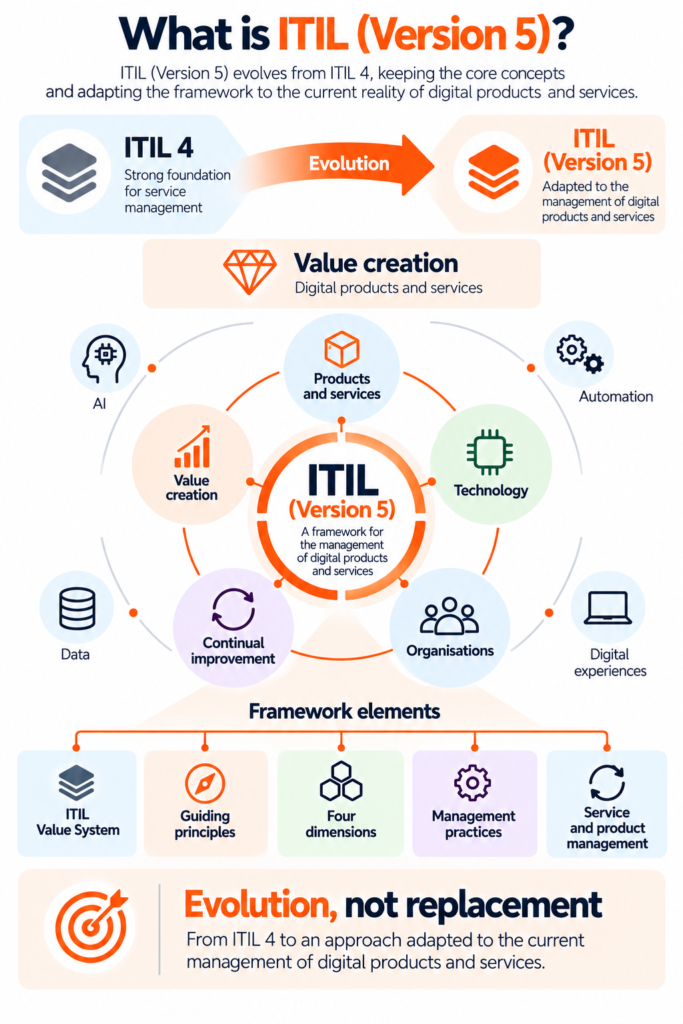
ITIL (Version 5) is the latest evolution of the ITIL framework.
The new version retains its focus on value creation while adapting the framework to the current context of managing digital products and services, taking technological developments and new ways of working into account.
Evolution of ITIL
ITIL (Version 5) develops concepts introduced in ITIL 4 and strengthens the connection between products, services, technology, organisations and value creation.
Key characteristics
Version 5 places greater emphasis on the management of digital products and services and on how organisations create, deliver and improve value.
The framework also takes into account the evolution of areas such as artificial intelligence, automation, data and digital experiences.
Structure
ITIL (Version 5) structures its approach around elements such as the ITIL Value System, guiding principles, four dimensions, management practices, continual improvement and the management of products and services throughout their lifecycle.
Relationship with ITIL 4
ITIL (Version 5) does not represent a break with ITIL 4. The new version develops concepts and elements from the previous version, adapting them to the current context of product and service management.
ITIL 4 vs ITIL (Version 5)
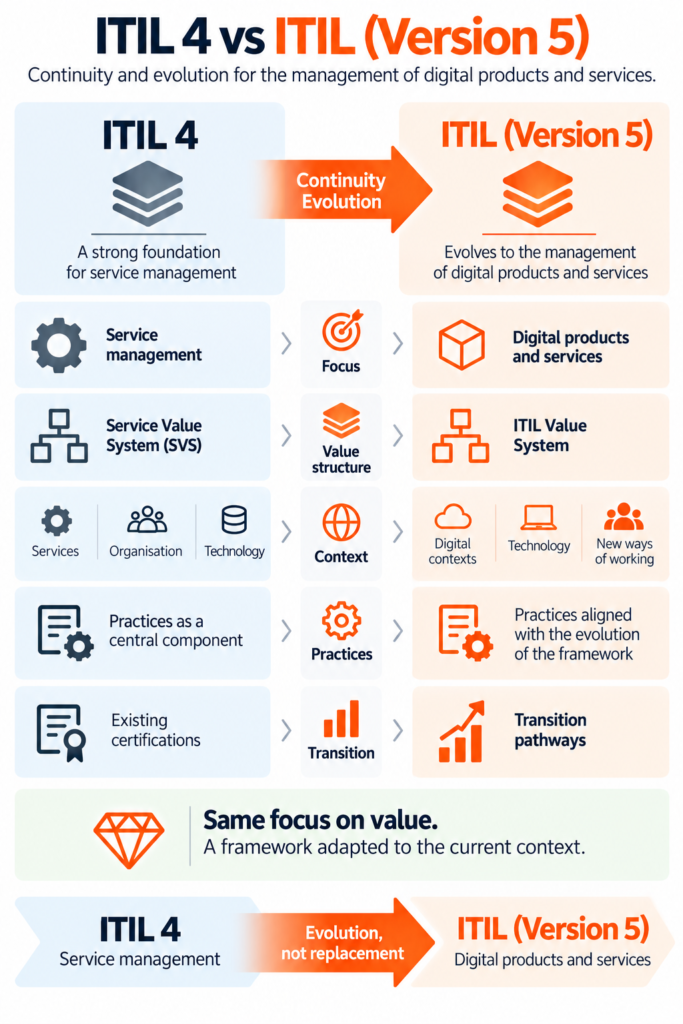
ITIL 4 and ITIL (Version 5) share the same fundamental focus on creating value through the management of products and services, but there are differences in how the framework is structured and in the areas that receive greater emphasis.
Key differences
ITIL 4 introduced an integrated view of service management through the Service Value System. ITIL (Version 5) evolves this approach, with greater emphasis on digital products and services and the current technological context.
Evolution of the framework
The evolution retains fundamental principles and concepts while adapting the framework to organisations working in increasingly complex and constantly changing digital environments.
Concepts and structure
One relevant difference is the terminology used for the value structure. ITIL 4 uses the Service Value System, while ITIL (Version 5) uses the ITIL Value System.
Practices
Practices continue to play a central role, but in Version 5 they are framed within the broader evolution of the framework and the current context of product and service management.
Certifications and transition
The transition to ITIL (Version 5) includes transition mechanisms for professionals who already hold previous ITIL certifications. The applicable pathway depends on the certification held and the certification being pursued.
What are ITIL practices?
What are practices?
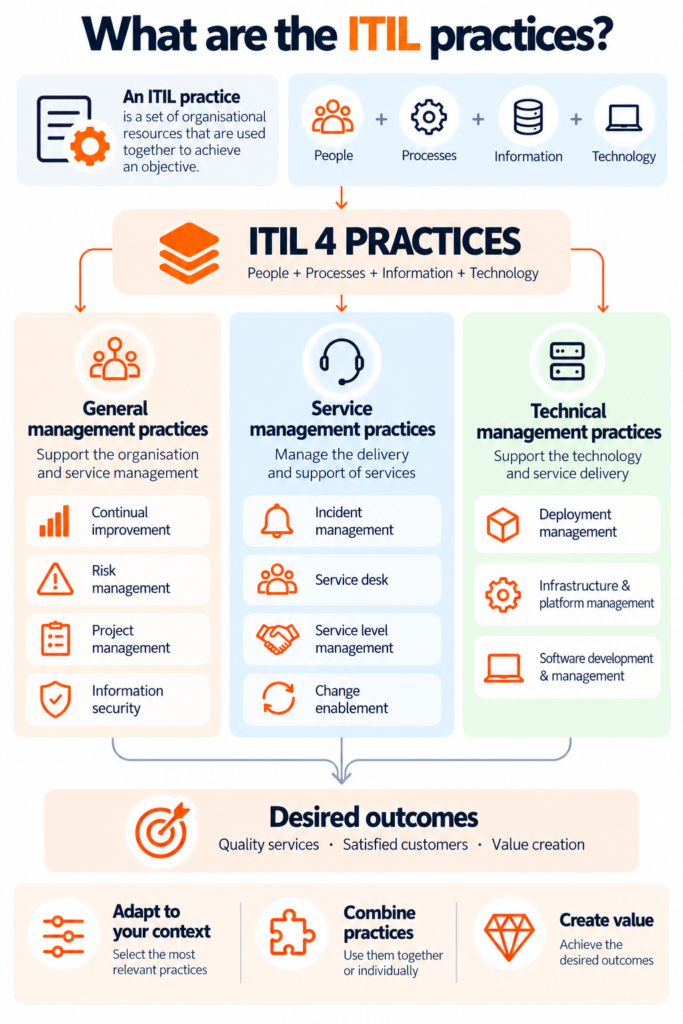
In ITIL 4, a practice is a set of organisational resources designed to perform work or achieve an objective.
Practices cover not only processes, but also people, responsibilities, information, technology and other resources needed to achieve the intended outcomes.
General management practices
General management practices apply to different areas of the organisation and not only to service management.
Examples include:
- Continual improvement
- Information security management
- Risk management
- Project management
- Relationship management
Service management practices
Service management practices are directly related to the management and delivery of services.
Examples include:
- Incident management
- Problem management
- Service desk
- Service level management
- Change enablement
- Service request management
Technical management practices
Technical management practices relate to specific technology areas.
Examples include:
- Deployment management
- Infrastructure and platform management
- Software development and management
Examples of ITIL practices
Practices can be applied individually or together, according to the organisation’s needs.
Applying an ITIL practice does not necessarily mean reproducing a particular way of working. The framework provides guidance that can be adapted to the organisational context.
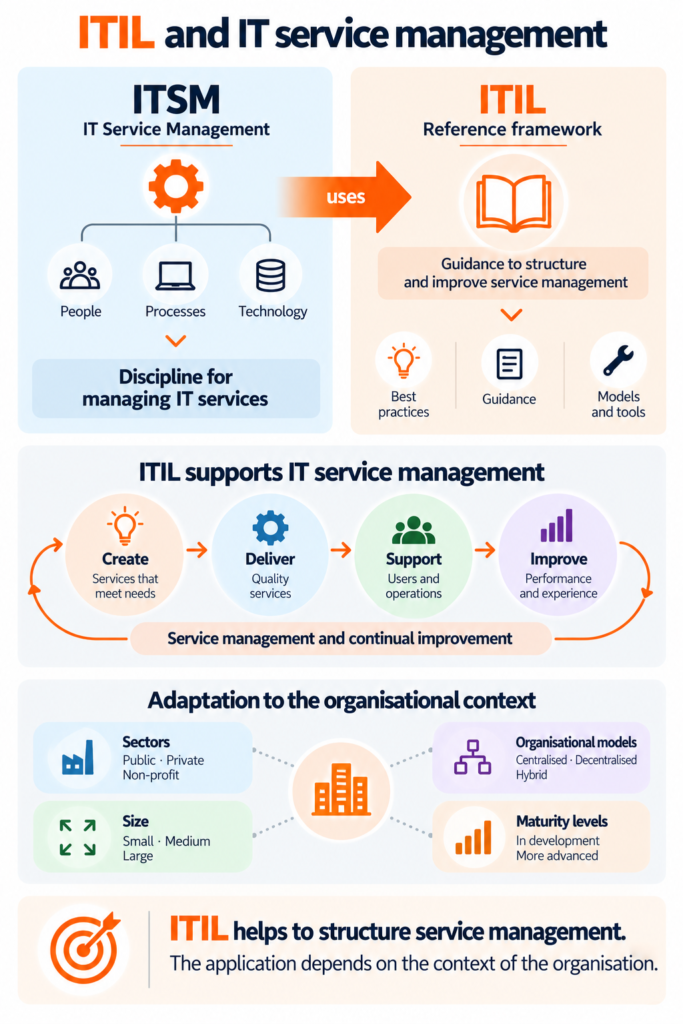
ITIL and IT service management
ITIL and IT Service Management (ITSM)
ITSM is the discipline of managing IT services. ITIL is one of the reference frameworks that can be used to structure and improve this management.
Therefore, ITIL and ITSM are not equivalent concepts: ITSM is the discipline; ITIL is a framework that provides guidance for its application.
Managing and improving services
ITIL helps integrate activities related to the creation, delivery, support and improvement of services.
The approach considers not only day-to-day operations, but also the need to adapt services as customer and organisational needs evolve.
Applying ITIL in different organisations
ITIL principles and practices can be adapted to different sectors, organisational sizes and operating models.
How ITIL is applied depends on the context, objectives and maturity of the organisation.
ITIL and other frameworks and approaches
ITIL can be used alongside other frameworks and approaches. The relationship depends on the purpose of each one and the context in which it is applied.
ITIL and COBIT
COBIT is focused on the governance and management of information and technology, while ITIL focuses primarily on the management of products and services.
An organisation can use COBIT to structure aspects of governance and control and ITIL to support service management.
ITIL and ISO/IEC 20000
ISO/IEC 20000 is an international standard for service management systems.
ITIL and ISO/IEC 20000 have related objectives in service management, but they are different concepts: ITIL is a framework providing guidance, while ISO/IEC 20000 defines requirements for a service management system.
ITIL and Agile
Agile brings together principles and approaches for developing products and responding iteratively to change.
ITIL can be applied in organisations that use Agile, including environments where development teams and service management teams work together.
ITIL and DevOps
DevOps aims to bring development and operations closer together, promoting collaboration, automation and continuous delivery.
ITIL can provide guidance for service management in environments where DevOps practices are used.
ITIL and PRINCE2
PRINCE2 is focused on project management. It helps structure and govern change by defining responsibilities, decision-making, control, risk management and project monitoring.
ITIL is focused on the management of products and services. It helps manage services, create and maintain value, and continually improve how they are delivered and supported.
In practice, the two approaches can be used at different stages of the same initiative. A project can use PRINCE2 to plan and manage the implementation of a new service or a significant change to an existing service. Once the change has been implemented, ITIL can provide guidance for managing and continually improving that product or service.
For example, the implementation of a new technology platform can be managed as a project using PRINCE2. Once implemented, the platform can become part of the organisation’s services, whose management may involve ITIL practices.
This relationship between projects and services is relevant in digital transformation contexts, where change resulting from projects needs to be integrated into the ongoing operation and management of products and services.
Explore PRINCE2 courses:
- PRINCE2 Foundation → https://xpmconsulting.com/en/course/prince2-foundation-certification/
- PRINCE2 Practitioner → https://xpmconsulting.com/en/course/prince2-practitioner-certification/
ITIL training
Training in this framework helps develop knowledge of its concepts, principles and practices and prepare for different ITIL certifications.
ITIL Foundation course
Training focused on the fundamentals of ITIL and preparation for the Foundation certification.
Explore the ITIL Foundation course → https://xpmconsulting.com/en/course/itil-foundation/
ITIL 4 Specialist: Monitor, Support and Fulfil
Specialist training for professionals who want to develop their knowledge of monitoring, support and fulfilment in ITIL 4.
Explore the ITIL 4 Specialist: Monitor, Support and Fulfil course → https://xpmconsulting.com/en/course/itil-4-specialist-monitor-support-and-fulfil-certification/
ITIL 4 Specialist: Create, Deliver and Support
Specialist training covering practices related to the creation, delivery and support of products and services in ITIL 4.
Explore the ITIL 4 Specialist: Create, Deliver and Support course → https://xpmconsulting.com/en/course/itil-4-specialist-create-deliver-and-support-certification/
To learn more about ITIL certifications, requirements, exams, costs and the certification pathway, see the ITIL Certification page.
Frequently asked questions about ITIL
What is ITIL?
ITIL is a reference framework for IT service management (ITSM). It provides concepts, principles and practices that help organisations manage and improve products and services and create value.
What does ITIL stand for?
ITIL stands for Information Technology Infrastructure Library.
What is ITIL used for?
ITIL helps organisations structure the management of products and services, improve their delivery and support, and promote value creation and continual improvement.
Is ITIL a framework?
Yes. ITIL is a framework, not a rigid methodology or a set of mandatory procedures. Its guidance can be adapted to the context, objectives and needs of each organisation.
What is the relationship between ITIL and ITSM?
ITSM (IT Service Management) is the discipline of managing IT services. ITIL is a reference framework that provides guidance for structuring and improving this management.
What is ITIL 4?
ITIL 4 is a version of the ITIL framework that introduced an integrated approach to service management through the Service Value System (SVS), the four dimensions, guiding principles, the Service Value Chain and ITIL practices.
What is ITIL (Version 5)?
ITIL (Version 5) is the latest version of the ITIL framework. It develops the approach introduced in ITIL 4 and adapts it to the current context of product and service management, with greater attention to digital environments and technological developments.
What is the difference between ITIL 4 and ITIL (Version 5)?
ITIL (Version 5) evolves the concepts and structure introduced by ITIL 4 while maintaining its focus on creating value through the management of products and services. One of the differences is the evolution from the Service Value System, used in ITIL 4, to the ITIL Value System in Version 5, together with greater adaptation to the current digital context.
Is ITIL a certification?
No. ITIL is a framework. There are different ITIL certifications that demonstrate knowledge and skills related to the framework, from Foundation to more advanced certifications.
What is ITIL Foundation?
ITIL Foundation is the entry-level certification in the ITIL certification pathway. It introduces the main concepts, principles and elements of the framework and provides a foundation of knowledge in product and service management.
Can ITIL be used with Agile and DevOps?
Yes. ITIL can be applied in organisations that use Agile and DevOps. The different approaches can coexist, with Agile supporting iterative ways of working and DevOps bringing development and operations closer together, while ITIL provides guidance for managing products and services.