
Scrum
A framework for working with complex products and problems, based on empiricism, collaboration and continuous adaptation. Explore its principles, events, accountabilities, artefacts and commitments.
What is Scrum?
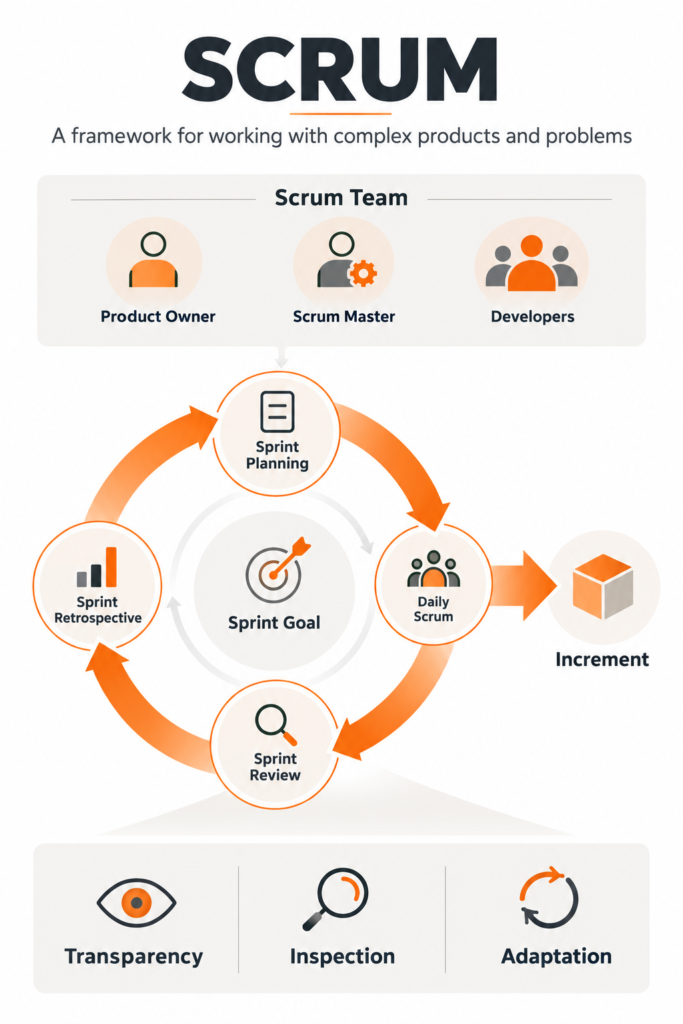
Scrum is a lightweight framework that helps people, teams and organisations generate value through adaptive solutions to complex problems.
It provides a clear structure for working in complex environments while allowing teams to learn from experience and adapt their approach as they progress. Rather than prescribing a detailed way of working, Scrum defines a small set of accountabilities, events, artefacts and commitments that support an empirical approach to product development.
Scrum is based on empiricism: decisions are made based on what is observed and learned, rather than on detailed predictions made in advance. Transparency, inspection and adaptation are therefore central to how Scrum works.
Scrum is often associated with software development, but it is not limited to this context. It can be used wherever teams are working on complex products or problems where requirements, priorities or solutions may evolve.
Is Scrum a methodology or a framework?
Scrum is a framework, not a methodology.
A methodology generally provides a more prescriptive approach, with defined processes, practices or steps to follow. Scrum deliberately takes a different approach. It establishes a structure within which teams can work, while leaving room for them to decide how best to accomplish their work.
This distinction is important when discussing Scrum methodology. Although “Scrum methodology” is a common search term, Scrum itself is officially defined as a framework.
What does Scrum mean?
The word Scrum is the name of the framework. It is not an acronym.
The term comes from rugby, where a scrum brings players together to work as a team towards a common objective. The term was later adopted in the context of product development to describe a collaborative and iterative way of working.
Scrum and Agile
Scrum and Agile are closely related, but they are not the same thing.
Agile is a broader approach based on values and principles for dealing with change, complexity and uncertainty. Scrum is a specific framework that provides a structure for applying an empirical and iterative approach to complex work.
In other words, Scrum is Agile, but Agile is not Scrum. There are other Agile approaches and frameworks, including Kanban and Extreme Programming (XP).
How does Scrum work?
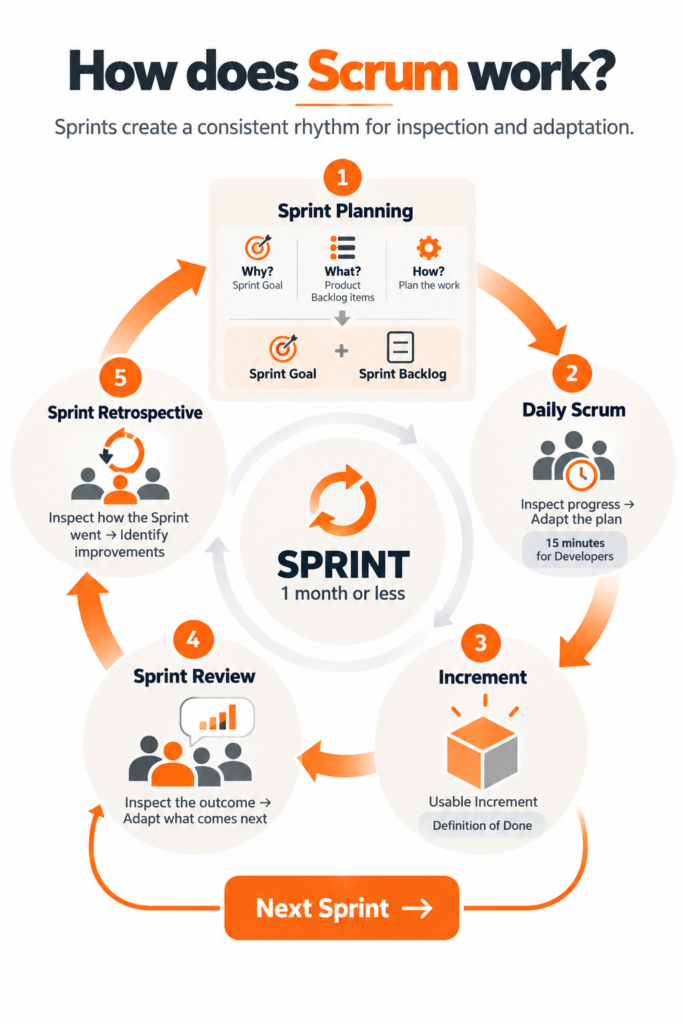
Scrum organises work into Sprints, short, fixed-length cycles during which the Scrum Team works towards a specific objective and creates a usable Increment.
The Scrum framework defines a number of events that take place during each Sprint.
The Sprint
A Sprint is a fixed-length event of one month or less. It contains all the other Scrum events and provides a consistent rhythm for inspection and adaptation.
During the Sprint, the Scrum Team works towards the Sprint Goal and creates an Increment that meets the
Definition of Done.
A new Sprint starts immediately after the previous Sprint ends.
Sprint Planning
The Sprint begins with Sprint Planning, where the Scrum Team establishes a plan for the work to be performed.
Sprint planning addresses three topics: the purpose of the Sprint, the work that can be accomplished, and how that work will be done.
The Scrum Team addresses three fundamental questions:
- Why? The Scrum Team defines the Sprint Goal, which communicates why the Sprint is valuable.
- What? The Developers select the Product Backlog items that can be accomplished during the Sprint.
- How? The Developers plan the work needed to create an Increment that meets the Definition of Done.
The outcome includes the Sprint Goal and the Sprint Backlog.
Daily Scrum
The Daily Scrum is a 15-minute event for the Developers. Its purpose is to inspect progress towards the Sprint Goal and adapt the Sprint Backlog as necessary.
The Scrum Guide does not prescribe a specific format or set of questions for the Daily Scrum. Developers can choose the structure and techniques that work best for them, as long as the event remains focused on progress towards the Sprint Goal and results in an actionable plan for the next day of work.
Sprint Review
The Sprint Review is an opportunity for the Scrum Team and stakeholders to inspect the outcome of the Sprint and determine what adaptations may be needed next.
It is more than a demonstration of completed work. The Sprint Review is a working session in which the Scrum Team and stakeholders discuss what has been achieved, changes in the environment and what to do next.
Sprint Retrospective
During the Sprint Retrospective, the Scrum Team inspects how the Sprint went in terms of individuals, interactions, processes, tools and the Definition of Done.
Together, team members identify the most useful changes to improve their effectiveness and quality. The most impactful improvements can be addressed as soon as possible and may become part of the Sprint Backlog for the next Sprint.
What are the Scrum accountabilities?
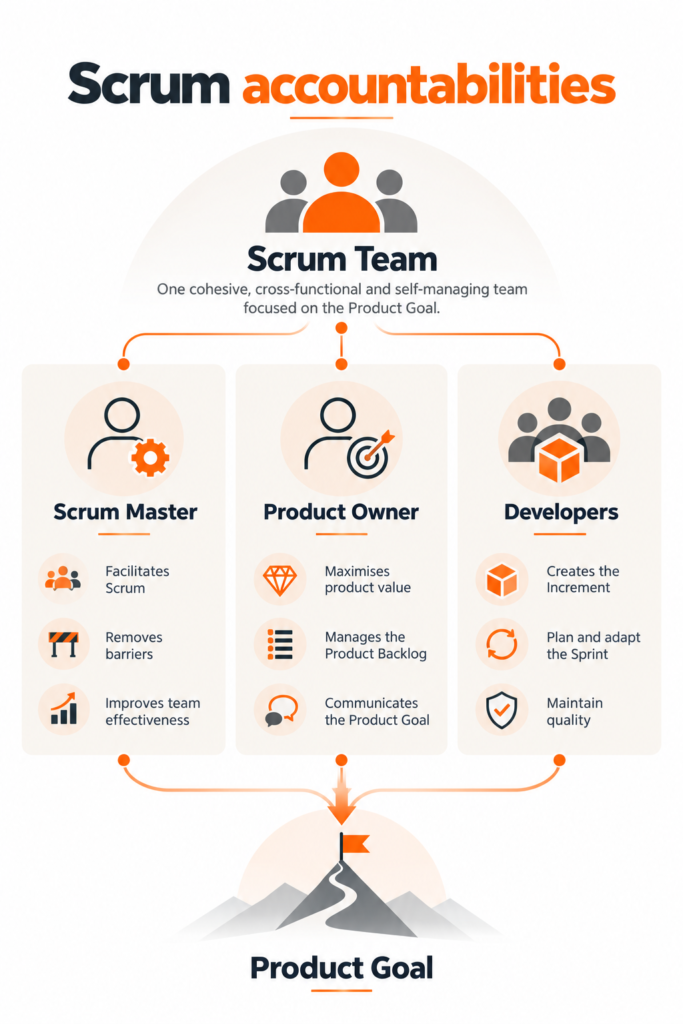
The Scrum Guide 2020 defines three accountabilities within the Scrum Team: Scrum Master, Product Owner and Developers.
The term “roles” is commonly used when referring to these three areas of responsibility, but the Scrum Guide uses the term accountabilities to emphasise the responsibilities associated with each one.
Scrum Master
The Scrum Master is accountable for establishing Scrum as defined in the Scrum Guide.
Within the Scrum Team and the wider organisation, the Scrum Master helps people understand and apply Scrum, removes barriers to effective implementation and works to improve the team’s effectiveness.
The Scrum Master is not a project manager or a task manager. The accountability focuses on enabling the Scrum Team and the organisation to work effectively within the Scrum framework.
Product Owner
The Product Owner is accountable for maximising the value of the product resulting from the work of the Scrum Team.
The Product Owner is responsible for effective Product Backlog management, including developing and communicating the Product Goal, creating and clearly communicating Product Backlog items, ordering them and ensuring that the Product Backlog is transparent, visible and understood.
Developers
The Developers are the people on the Scrum Team who are committed to creating a usable Increment each Sprint.
Developers are responsible for creating a plan for the Sprint, maintaining quality by adhering to the Definition of Done, adapting their plan each day towards the Sprint Goal and holding each other accountable as professionals.
The term Developers does not refer only to software programmers. It describes the people within the Scrum Team who are responsible for creating the Increment.
Scrum Team
The Scrum Team consists of the Product Owner, the Scrum Master and the Developers.
The Scrum Team is a cohesive unit of professionals focused on one objective: the Product Goal. Scrum Teams are cross-functional and self-managing, meaning they decide internally who does what, when and how.
What are the Scrum artefacts?
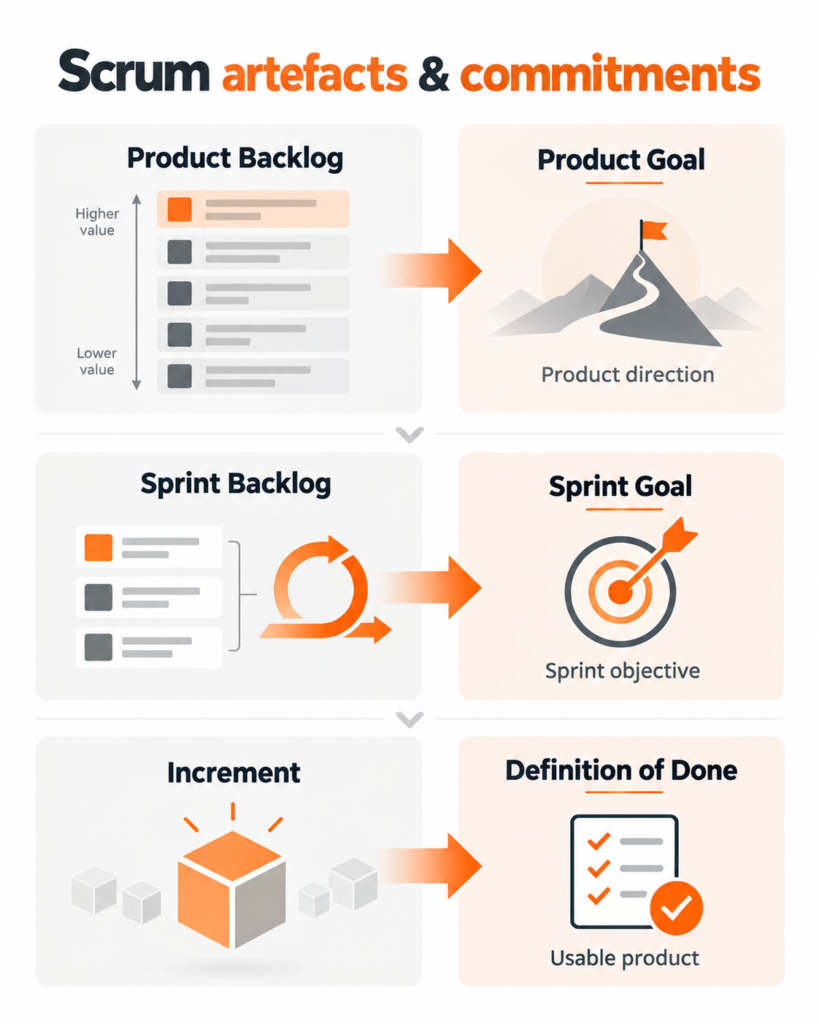
Scrum defines three artefacts, each designed to provide transparency of important information needed to inspect and adapt the work.
Product Backlog
The Product Backlog is an emergent, ordered list of what is needed to improve the product.
It is the single source of work undertaken by the Scrum Team and includes the work necessary to achieve the Product Goal.
Sprint Backlog
The Sprint Backlog consists of the Sprint Goal, the set of Product Backlog items selected for the Sprint, and an actionable plan for delivering the Increment.
It provides the Developers with a visible and evolving plan for achieving the Sprint Goal.
Increment
An Increment is a concrete stepping stone towards the Product Goal.
Each Increment must be usable and meet the Definition of Done. Multiple Increments may be created within a single Sprint, and Increments can be delivered before the end of the Sprint.
What are the Scrum commitments?
Each Scrum artefact contains a commitment that provides a clear focus for inspection and progress.
Product Goal
The Product Goal describes a future state of the product that can serve as a target for the Scrum Team’s planning.
It is contained in the Product Backlog and provides the long-term objective towards which the Scrum Team works.
Sprint Goal
The Sprint Goal is the single objective for the Sprint.
It creates flexibility in terms of the exact work required to achieve it while providing the Scrum Team with a common focus throughout the Sprint.
Definition of Done
The Definition of Done is a formal description of the state of the Increment when it meets the quality measures required for the product.
When a Product Backlog item meets the Definition of Done, an Increment is created.
What are the Scrum pillars and values?
Scrum is based on empiricism and supported by five values that guide the behaviour of the Scrum Team.
The three pillars of empiricism
The three pillars of empiricism in Scrum are Transparency, Inspection and Adaptation.
- Transparency means that important aspects of the process must be visible to those responsible for the outcome.
- Inspection means that Scrum artefacts and progress towards goals are inspected frequently enough to detect potentially undesirable variances or problems.
- Adaptation means that the process or the work must be adjusted when inspection identifies that something is outside acceptable limits.
These three pillars enable Scrum Teams to learn from what is happening and adapt their work accordingly.
The five Scrum values
Scrum values are Commitment, Focus, Openness, Respect and Courage.
The Scrum Team commits to achieving its goals, focuses on the work of the Sprint, remains open about the work and challenges, respects one another as capable and independent professionals, and has the courage to do the right thing and work on difficult problems.
Scrum in project management
Scrum can be used in project management contexts, particularly when the work involves complexity, uncertainty and the need to adapt as new information becomes available.
However, Scrum should not be understood as a traditional project management methodology. It provides a framework for teams to create value through iterative and incremental work, rather than prescribing a complete project management process.
Scrum can therefore be part of a broader project environment where other approaches, practices or governance mechanisms are also used.
Scrum and Agile: what is the difference?
Agile is broader than Scrum. Agile describes a set of values and principles that emphasise delivering value, responding to change, collaboration and iterative development.
Scrum is a specific framework that provides a defined structure for applying an empirical approach to complex work.
The two are therefore not competing alternatives. Scrum is one way of working within the broader Agile landscape.
Scrum and Kanban: what are the differences?
Kanban and Scrum both support adaptive ways of working, but they organise work differently.
Scrum provides a defined framework based on Sprints, accountabilities, events, artefacts and commitments. Kanban focuses primarily on managing the flow of work, visualising work and limiting work in progress.
A Scrum Team can also use Kanban practices to improve its understanding and management of workflow. The two approaches are therefore not necessarily mutually exclusive.
Scrumban
Scrumban is an informal term commonly used to describe approaches that combine elements of Scrum and Kanban.
It is not a framework defined by the Scrum Guide. The specific practices used in a Scrumban approach depend on the context and needs of the team.
Scrum and other approaches
Scrum can be used alongside other approaches and practices. Understanding how they differ helps organisations decide how they can be combined in a particular context.
Scrum and DevOps
DevOps and Scrum address different aspects of product delivery.
Scrum provides a framework for working on complex products through iterative development and empirical learning. DevOps focuses on collaboration between development and operations, automation and the practices that support the reliable and efficient delivery and operation of software.
A team can therefore use Scrum as its framework while adopting DevOps practices.
Scrum and XP
Extreme Programming (XP) is an Agile approach that includes a strong focus on software development practices, such as continuous integration, test-driven development and pair programming.
Scrum does not prescribe specific technical practices. Software teams using Scrum can therefore adopt practices from XP when they are appropriate to their context.
Scrum and Lean
Lean focuses on creating value, reducing waste, improving flow and supporting continuous improvement.
Scrum and Lean have different origins and structures, but they can be used together. Scrum’s empirical approach and focus on delivering value can be complemented by Lean thinking and practices.
Scrum certifications
Scrum training
Learning Scrum involves more than memorising its accountabilities, events, artefacts and terminology. Understanding how the framework works, why it is structured this way and how to apply it in real situations is essential to developing practical Scrum knowledge.
XPM Consulting provides training focused on the practical application of Scrum and related Agile approaches.
Scrum Master course
Training focused on the Scrum Master accountability, the Scrum framework and its practical application.
Explore the Scrum Master Course → https://xpmconsulting.com/en/course/scrum-master/
Scrum Master II
Advanced training for professionals who want to deepen their understanding and practical application of the Scrum Master accountability.
Explore the Scrum Master II Course → https://xpmconsulting.com/en/course/advanced-scrum-master/
Product Owner course
Training focused on the Product Owner accountability, Product Backlog management and value creation.
Explore the Product Owner Course → https://xpmconsulting.com/en/course/product-owner/
Agile Product Owner
Training for professionals who are taking on, or planning to take on, Product Owner responsibilities and want to develop their product management skills in an Agile environment.
Explore the Agile Product Owner Course → https://xpmconsulting.com/en/course/product-owner-certification/
Agile Coach course
Training focused on Agile coaching, supporting teams and organisations in adopting and improving Agile ways of working.
Explore the Agile Coach Course → https://xpmconsulting.com/en/course/agile-coach-certification/
Frequently asked questions about Scrum
What is Scrum?
Scrum is a lightweight framework that helps people, teams and organisations generate value through adaptive solutions for complex problems. It is based on empiricism, with transparency, inspection and adaptation at its core.
What is Scrum used for?
Scrum is used to help teams work on complex products and problems where requirements, priorities and solutions may change as new information becomes available.
How does Scrum work?
Scrum organises work into fixed-length Sprints of one month or less. Each Sprint includes events such as Sprint Planning, Daily Scrum, Sprint Review and Sprint Retrospective, supported by Scrum artefacts and commitments.
Is Scrum a methodology?
No. Scrum is a framework, not a methodology. It defines a structure for working on complex problems without prescribing every process, practice or step the team must follow.
Is Scrum a framework?
Yes. Scrum is a lightweight framework for helping people, teams and organisations generate value through adaptive solutions to complex problems.
What is the difference between Scrum and Agile?
Agile is a broader approach based on values and principles for responding to change and complexity. Scrum is a specific framework that provides a structure for applying an empirical and iterative approach to complex work.
What is the difference between Scrum and Kanban?
Scrum defines a framework based on Sprints, accountabilities, events, artefacts and commitments. Kanban focuses on managing the flow of work, visualising work and limiting work in progress. Teams can also combine Scrum with Kanban practices.
What are the Scrum roles?
The Scrum Guide 2020 uses the term accountabilities rather than roles. The three Scrum accountabilities are Scrum Master, Product Owner and Developers, who together form the Scrum Team.
What does a Scrum Master do?
The Scrum Master is accountable for establishing Scrum as defined in the Scrum Guide and helping the Scrum Team and the organisation understand and apply it. The Scrum Master also works to improve the effectiveness of the Scrum Team.
What does a Product Owner do?
The Product Owner is accountable for maximising the value of the product resulting from the work of the Scrum Team. This includes effective Product Backlog management and defining and communicating the Product Goal.
What is a Sprint?
A Sprint is a fixed-length Scrum event of one month or less. During the Sprint, the Scrum Team works towards the Sprint Goal and creates a usable Increment that meets the Definition of Done.
What are the Scrum artefacts?
The three Scrum artefacts are the Product Backlog, Sprint Backlog and Increment. Each has an associated commitment: the Product Goal, Sprint Goal and Definition of Done.
What are the Scrum values?
The five Scrum values are Commitment, Focus, Openness, Respect and Courage. They guide the behaviour and collaboration of the Scrum Team.
What are the pillars of Scrum?
Scrum is based on three pillars of empiricism: Transparency, Inspection and Adaptation. Together, they enable teams to inspect their work and progress and adapt when necessary.
Can Scrum be used in project management?
Yes. Scrum can be used in project management contexts, particularly where the work involves complexity and uncertainty. However, Scrum is a framework rather than a traditional project management methodology.
Can Scrum be used for software development?
Yes. Scrum can be used for software development and is widely used in this context. However, Scrum is not limited to software and can be applied to other complex products and problems.
Is Scrum certification necessary?
No. Scrum certification is not a requirement for using Scrum. Professionals and teams can learn and apply the framework without holding a certification.
What Scrum certifications are available?
There are several Scrum certifications offered by different organisations. Their requirements, assessment methods, learning formats and certification structures vary depending on the certifying organisation.