
Scrum Master Certification
Develop the skills to apply Scrum, support Agile teams and promote continuous improvement, while preparing to obtain an internationally recognised certification.
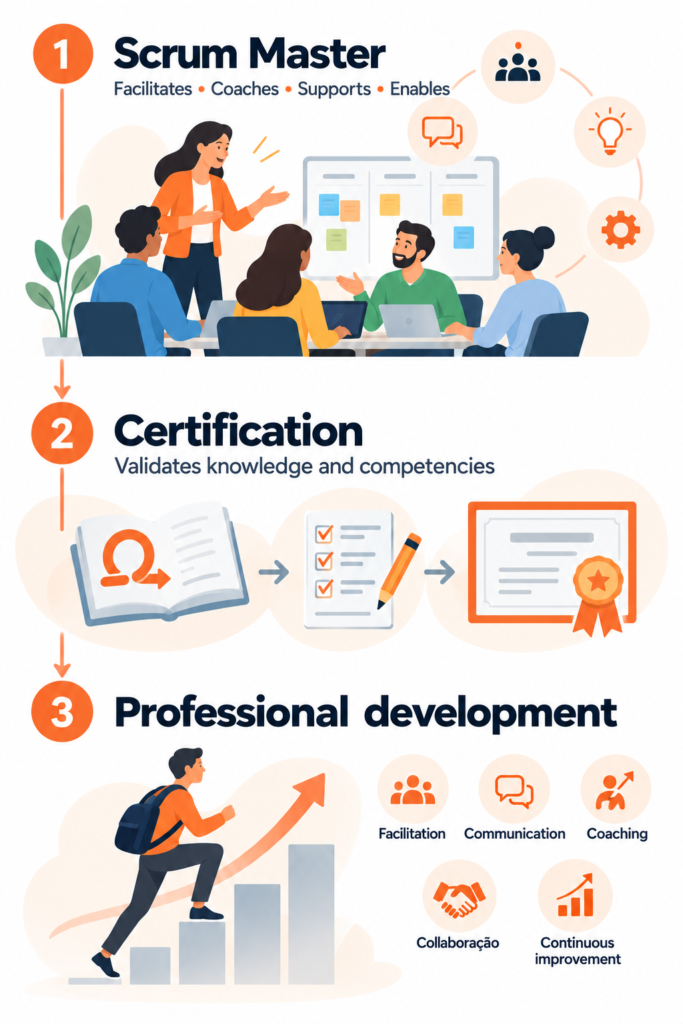
A Scrum Master certification validates knowledge of Scrum and the responsibilities associated with the Scrum Master role. It can provide a recognised way to demonstrate knowledge of Scrum and support professional development in Agile and Scrum environments.
There are different Scrum Master certifications, with varying requirements, assessment methods, costs and validity periods. Understanding these differences can help professionals choose a certification that matches their objectives and professional context.
What is a Scrum Master certification?
What is a Scrum Master?
Scrum Master is responsible for helping establish Scrum as defined in the Scrum Guide and supporting the Scrum Team in creating an environment where Scrum can be applied effectively.
The role involves facilitation, coaching, collaboration, removing impediments and supporting continuous improvement. The Scrum Master also helps the organisation understand and apply Scrum appropriately.
What does a Scrum Master certification validate?
A Scrum Master certification demonstrates that a professional has acquired knowledge of Scrum and understands the responsibilities associated with the Scrum Master role.
Depending on the certification, the assessment may cover Scrum principles, roles and responsibilities, events, artefacts, commitments, facilitation, coaching and the practical application of Scrum.
Scrum Master certification and professional development
A Scrum Master certification can support professionals who are starting their career in Agile environments as well as those who already work with Scrum teams.
Certification provides evidence of knowledge. Practical experience is essential for developing the ability to apply that knowledge effectively in real-world situations.
What is a Scrum Master certification for?
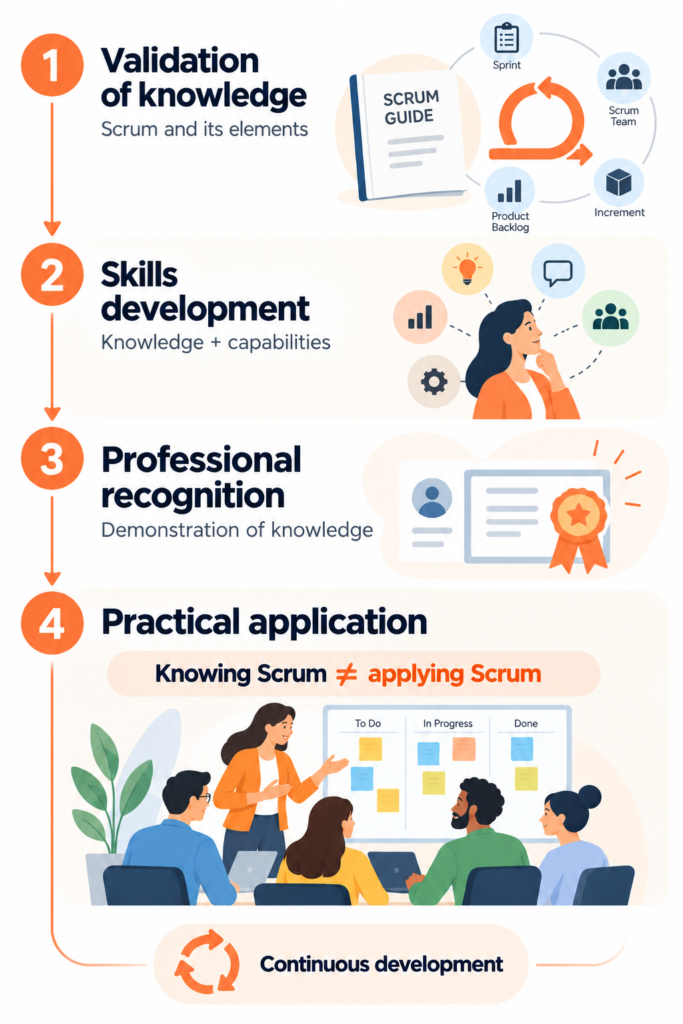
Validating knowledge of Scrum
A certification provides a formal way of demonstrating knowledge of Scrum, its principles, framework and terminology.
Developing Scrum Master skills
Preparing for a certification can help professionals structure their knowledge and develop skills related to facilitation, coaching, collaboration and continuous improvement.
Professional recognition
A Scrum Master certificate can provide evidence of Scrum knowledge when applying for roles or working with organisations that use Scrum and Agile approaches.
Applying Scrum in practice
Certification is only one part of professional development. Applying Scrum in real projects and working with Scrum Teams is essential for developing practical experience.
What Scrum Master certifications are available?
There are several Scrum Master certification programmes offered by different organisations. They can differ significantly in their requirements, examination formats, assessment criteria, costs and validity.
Some certifications require specific training before the assessment, while others have different preparation requirements.
When comparing a Scrum Master certification, it is useful to consider:
- The Scrum reference and content covered
- Eligibility and prerequisites
- Training requirements
- Examination format
- Assessment criteria and passing requirements
- Certification validity
- Renewal requirements
- Total cost
- Recognition in the professional environments where the certification will be used
Scrum Master certifications based on the Scrum Guide
The reference used by a certification is also an important consideration.
Certifications based on the Scrum Guide provide a common reference for understanding Scrum and using consistent terminology. This shared language can be particularly valuable in international, distributed and multicultural teams.
When professionals from different countries and organisations use the same concepts and terminology to describe Scrum, communication and collaboration can become easier and expectations can be more clearly aligned.
For professionals working with international teams, a certification based on a common Scrum reference can therefore be a relevant consideration.
Lifetime Scrum Master certifications and certifications that require renewal
Certification validity can also vary between Scrum Master certification programmes.
Some certifications are lifetime certifications, meaning that they do not require renewal after they have been obtained. Others have a defined validity period and require periodic renewal.
A lifetime certification avoids future renewal fees and administrative procedures. When a certification does not require periodic knowledge updates, not having to repeat the renewal process can be a practical advantage.
Certification programmes that require renewal may, on the other hand, include continuing professional development requirements.
When comparing certifications, it is therefore useful to understand what renewal involves, what it costs and what additional value it provides.
How do Scrum Master certifications work?
Requirements and prerequisites
Requirements vary depending on the certification. Some programmes have no previous experience requirement, while others may require training or other prerequisites.
The certification requirements should always be checked before starting the preparation process.
Training and preparation
Some Scrum Master certifications require candidates to complete specific training. Others allow candidates to prepare through different means.
Preparation may include studying the Scrum Guide, reviewing Scrum principles and practices, working through practical scenarios and completing practice questions.
Examination and assessment
The assessment format depends on the certification. It may include multiple-choice questions, scenario-based questions or other forms of assessment.
The number of questions, duration, passing score and retake conditions also vary.
Certification
After successfully completing the required assessment, the candidate receives the corresponding certification.
The certification may have lifetime validity or require periodic renewal, depending on the certification programme.
Cost
The total cost of a Scrum Master certification can include:
- Training fees
- Examination fees
- Study materials
- Retake fees
- Renewal fees, where applicable
The cost should therefore be assessed based on the complete certification process rather than the examination fee alone.
What is assessed in a Scrum Master certification?
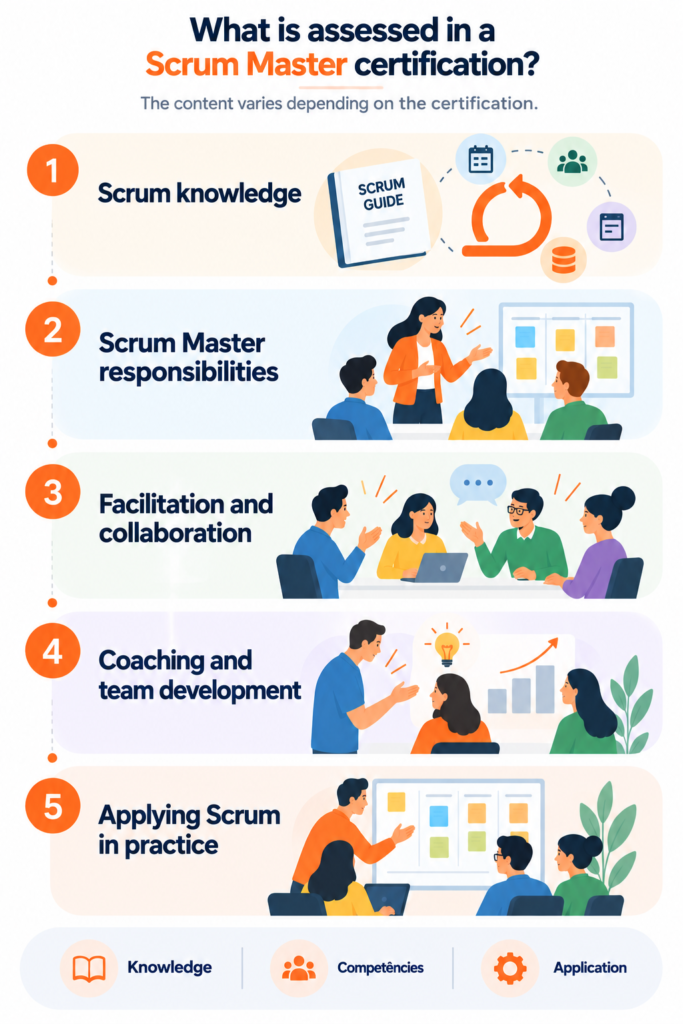
The exact assessment criteria vary between certifications, but a Scrum Master exam may cover areas such as:
- Scrum principles and values
- The Scrum Team and its responsibilities
- Scrum events
- Scrum artefacts
- Scrum commitments
- Facilitation
- Coaching
- Collaboration
- Removing impediments
- Continuous improvement
- Applying Scrum in practical situations
Understanding the Scrum framework is important, but effective Scrum Master practice also requires the ability to work with people, teams and organisations.
The Scrum Guide and Scrum Master certification
What is the Scrum Guide?
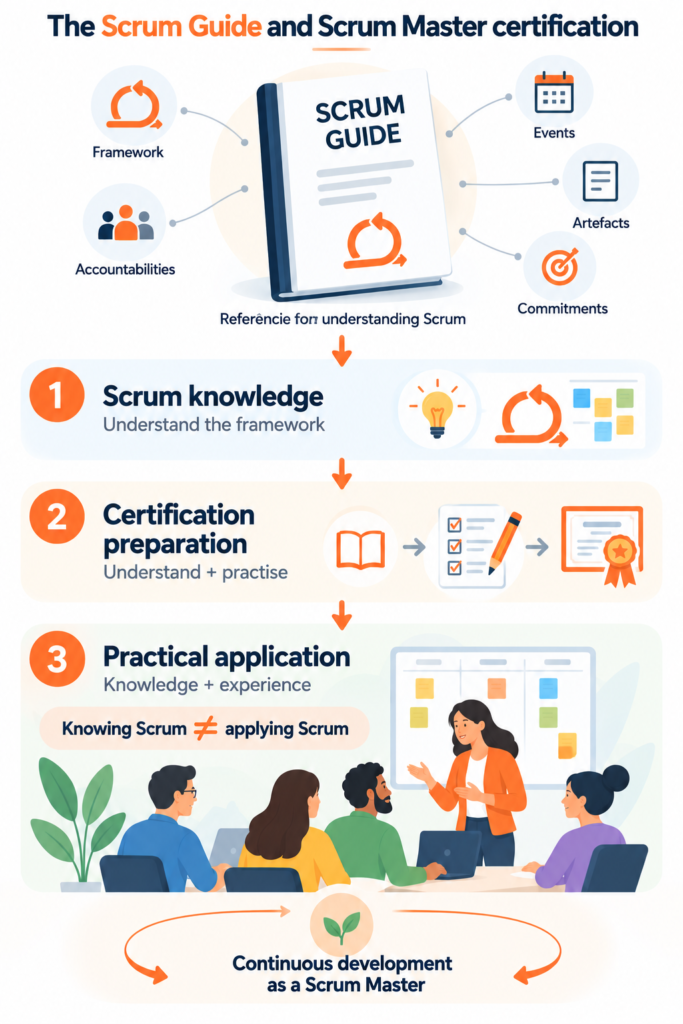
The Scrum Guide is the reference document that defines Scrum, including its framework, accountabilities, events, artefacts and commitments.
It provides the terminology and definitions used to describe Scrum consistently.
The Scrum Guide as a reference for certification
For professionals preparing for a Scrum Master certification, the Scrum Guide is an important reference for understanding the Scrum framework and its terminology.
It can also help candidates identify the fundamental concepts that should be understood before taking a certification assessment.
How to use the Scrum Guide when preparing
Preparation should start with a thorough understanding of the Scrum Guide and its concepts.
Candidates should also review the specific requirements and assessment criteria of the certification they intend to take, as these may include additional content or practical scenarios.
Knowledge of Scrum and practical application
Knowing the Scrum Guide is essential, but knowledge alone does not develop practical Scrum Master experience.
Working with Scrum Teams provides opportunities to apply Scrum, facilitate collaboration, support continuous improvement and deal with real organisational challenges.
How to choose a Scrum Master certification
There is no single certification model that is appropriate for every professional. The choice depends on the individual’s objectives, professional context and the requirements of the certification.
Relevant factors include:
Professional objectives
Consider how the certification fits into your current role and future career plans.
Content and assessment
Check what the certification covers and how knowledge is assessed.
Requirements
Review prerequisites, training requirements and any experience requirements before starting the certification process.
Examination format
Consider the type of assessment, number of questions, duration, passing requirements and retake conditions.
Recognition
Consider whether the certification is recognised in the organisations, markets or professional environments where you intend to use it.
Validity and renewal
Check whether the certification is lifetime or requires periodic renewal, as well as the associated costs and requirements.
Training and preparation
Check whether training is mandatory and what preparation resources are available.
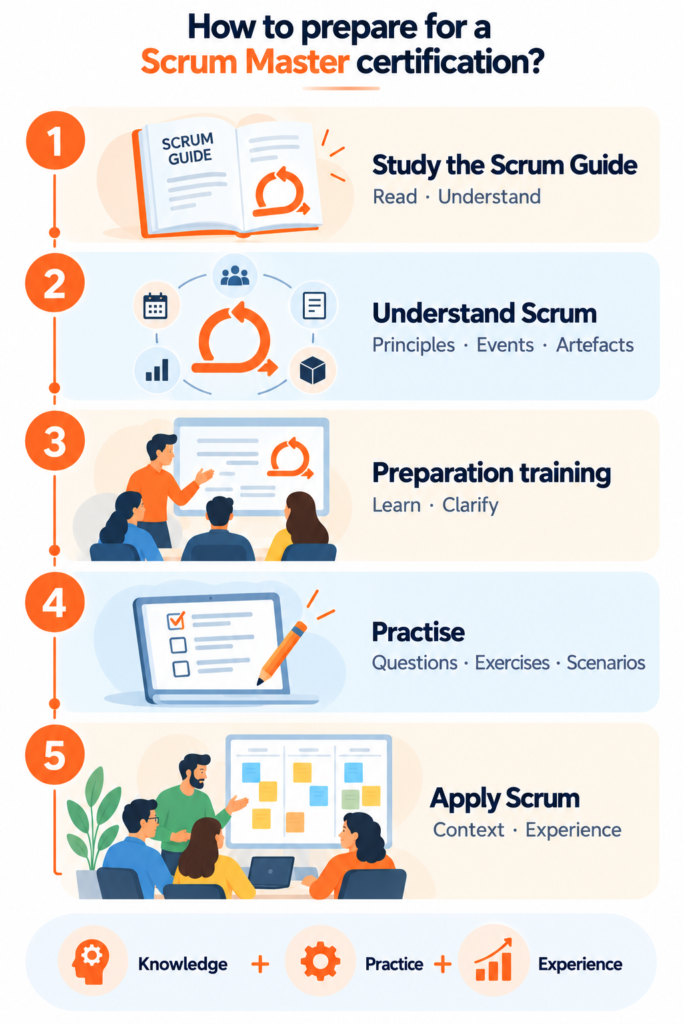
How to prepare for a Scrum Master certification
Study the Scrum Guide
The Scrum Guide should be a central reference when preparing for a Scrum Master certification.
Understanding the definitions, accountabilities, events, artefacts and commitments is essential.
Understand Scrum principles and practices
Preparation should go beyond memorising terminology. Candidates should understand how Scrum works as a framework and how its principles apply to different situations.
Take structured training
A structured Scrum Master training programme can help organise the content, clarify concepts and provide opportunities to work through practical situations.
Practise with questions and scenarios
Practice questions can help candidates become familiar with the type of assessment they may encounter and identify areas that require further study.
Practical scenarios are particularly useful for developing the ability to apply Scrum concepts rather than simply recalling definitions.
Apply Scrum in practice
Practical experience complements certification preparation and helps develop the skills required to work effectively with Scrum Teams.
Scrum Master certification, training and experience
Certification and training
Training and certification are not the same thing.
Training provides structured learning and preparation. Certification is a formal credential awarded after meeting the requirements and successfully completing the relevant assessment.
Certification and practical experience
A certification demonstrates knowledge, but it does not replace practical experience.
Working with Scrum Teams allows professionals to develop skills that are difficult to acquire through examination preparation alone.
Can you obtain a Scrum Master certification without experience?
Some Scrum Master certifications can be obtained without previous professional experience. Requirements vary between certification programmes.
Even when experience is not required for certification, practical experience is important for developing the ability to perform the Scrum Master role effectively.
The importance of practice after certification
Obtaining a certification is not the end of the learning process.
Applying Scrum in real environments, working with teams and reflecting on practical situations allows professionals to continue developing their skills.
Scrum Master training
Scrum Master course
XPM Consulting provides Scrum Master training designed to help professionals prepare for different certifications and develop practical knowledge of Scrum.
Explore de Scrum Master course → https://xpmconsulting.com/en/course/scrum-master/
European Certified Agile Coach
XPM Consulting also provides the European Certified Agile Coach (EC-AglC) certification, which develops skills directly applicable to Scrum Master work, including facilitation, coaching, collaboration, team development and continuous improvement.
Explore the European Certified Agile Coach certification → https://xpmconsulting.com/en/course/agile-coach-certification/
Frequently asked questions about Scrum Master certification
What is a Scrum Master certification?
A Scrum Master certification is a professional credential that validates knowledge of Scrum and the responsibilities associated with the Scrum Master role.
What is a Scrum Master certification for?
It provides a formal way to demonstrate knowledge of Scrum and can support professional development and career progression in Agile and Scrum environments.
What Scrum Master certifications are available?
There are several Scrum Master certifications. They differ in requirements, training, examination format, assessment criteria, validity and renewal requirements.
Is training required to obtain a Scrum Master certification?
It depends on the certification. Some programmes require specific training, while others have different preparation requirements.
Is experience required for a Scrum Master certification?
Not necessarily. Some certifications can be obtained without previous professional experience. Requirements vary between certification programmes.
How does a Scrum Master certification exam work?
The examination format varies. Depending on the certification, it may include multiple-choice or scenario-based questions. The number of questions, duration, passing score and retake conditions also vary.
How much does a Scrum Master certification cost?
The cost varies between certification programmes and may include training, examination fees, study materials, retakes and renewal fees.
How long is a Scrum Master certification valid?
Some Scrum Master certifications are lifetime certifications, while others have a defined validity period and require renewal.
Do you need to renew a Scrum Master certification?
Not always. Some certifications are lifetime and do not require renewal. Others require periodic renewal or continuing professional development.
How do you prepare for a Scrum Master certification?
Start by studying the Scrum Guide and understanding Scrum principles, practices and responsibilities. Training, practice questions and practical scenarios can also support preparation.
Is the Scrum Guide enough to prepare for a Scrum Master certification?
The Scrum Guide is an essential reference, but it may not cover all the content assessed by every certification. Candidates should also check the specific requirements and assessment criteria of the certification they intend to take.
What is the difference between certification and Scrum Master training?
Training provides structured learning and preparation. Certification is a professional credential awarded after meeting the relevant requirements and successfully completing the assessment.
Does a Scrum Master certification replace practical experience?
No. Certification validates knowledge, while practical experience develops the ability to apply Scrum effectively in real-world situations.
How do you choose a Scrum Master certification?
Consider the content, requirements, training, examination format, passing requirements, recognition, validity, renewal conditions and total cost. It is also useful to check whether the certification is based on the Scrum Guide.
Are Scrum Master and Agile Coach the same thing?
The two areas involve many of the same skills, including facilitation, coaching, collaboration, team development and continuous improvement. These skills are directly relevant to working with Scrum Teams.
Does Scrum Master training prepare you for certification?
It can. A structured Scrum Master course can support certification preparation, but the extent to which it prepares candidates depends on the requirements and assessment criteria of the certification concerned.